Khóa học
IELTS Online
IELTS Online
Giảm đến 18%
Đăng ký ngay
Mục lục [Ẩn]
Khi ôn tập IELTS Reading, việc luyện kĩ năng giải đề qua các đề thi thật là một cách hiệu quả giúp bạn tăng band điểm nhanh. Bài viết này, bạn sẽ cùng tìm hiểu và chinh phục đề thi IELTS Reading “Classical music over the centuries”, bao gồm toàn bộ đề bài, câu hỏi, đáp án chi tiết và phần giải thích rõ ràng cho từng câu. Đây là tài liệu ôn luyện IELTS chất lượng giúp bạn củng cố kỹ năng đọc hiểu, mở rộng vốn từ học thuật và rèn chiến thuật làm bài hiệu quả, từ đó tăng band điểm nhanh chóng và tự tin hơn khi bước vào kỳ thi chính thức.
| Bạn đang ở band IELTS bao nhiêu? Làm bài test miễn phí và nhận ngay lộ trình học cá nhân hóa. 👉 Đăng ký test IELTS miễn phí ngay |

READING PASSAGE 2
Classical music over the centuries
A
The production of any great art form, and classical music is no exception, does not usually occur in a society dominated by the basic material demands of food and shelter. Art and music have flourished in those periods of history, and those parts of society, in which the luxury of free time and material wealth has allowed such a culture to take precedence over more material matters. In the medieval European world, it was thus primarily in the closed communities of the church and monastery, and royal courts that music, literature, and learning were able to flourish.
B
It was not until the 18th century that this situation changed to any great extent, and the rise of an economically independent middle class meant that concert-going became a public activity for anyone who cared to buy a ticket. It is worth remembering that the idea of classical music widely accepted today did not exist until about 300 years ago. Performing music in concert halls to a paying audience, as something inherently pleasurable and significant, was pretty much unheard of until the 18th century, and not widely established until the 19th. The concert venue, the audience, and the idea of masterpieces of classical music, were all effectively invented during the course of the 18th century in London, Paris, Vienna, Berlin, and other European cities where the arts in general were blossoming.
C
Today, music that was originally written for a concert venue may appear, out of its original context, in an advert or film. Conversely, music written specifically for films is sometimes performed live. But nothing has changed music over the last century more radically than the invention and dissemination of recording technologies. However, although Thomas Edison originally developed the phonograph in 1877, and wax cylinders were used as early as the 1880s for recording music, commercial recordings of music were not generally available to the majority until the 1920s. From the mid-1980s onwards, the vinyl disc gradually gave way to the new technology of the CD, but just a decade later, the digital MP3 file was already displacing the CD as the favoured way to produce recorded music. Yet now, people have more music stored on their phones or computers—which they can call up with the touch of a finger—than would have been contained on all the metres of library shelves of a proud 'record collector' of the 20th century.
D
Before recording, music was a social event—it involved one or more people coming together to make music. The music lasted for as long as the musicians sang or played, and then it was over. Therefore, the only music that was heard tended to be compositions by recent or living musicians, probably working in the locality. It was rare to hear music from a past generation, distant place, or culture. Even when music became professionalized, people who wanted to listen to music went to a specific venue, at a specific time, to hear musicians create a one-off event.
E
Nowadays, however, technology makes almost all the world's music instantly available to anyone with access to simple and cheap gadgets for playing it. Music thus floats free of any specific occasion or venue. It is no longer restricted to a particular audience or group of musicians. For the first time, listening to music can be entirely a personal affair. This is one of the reasons the classical label becomes harder to pin down. One of its distinctive features—a performance defined by concert halls and opera houses—is dissolved by recording formats. As a consequence, all music, classical music included, can be any person's soundtrack for activities such as commuting, exercising, or working.
F
The ubiquity of music as recorded sound means that it's very easy to overlook the most definitive aspect of the classical music tradition—the fact that it is written or notated music. Though classical music may lack a precise definition and mean quite different things to different people, at its heart is the idea of music that has remained viable over the years because it was written down in notation. The origins of what music historians think of as classical music lie in the ninth century when a system of musical notation was first developed. Before this time, singers in religious services in cathedrals or monasteries had to learn by heart a huge repertory of chants. The first attempts to notate music were intended to help them remember these. Over the next centuries, notation became more complex, incorporating such aspects as rhythm and pitch, allowing composers to rework and refine their musical ideas. Put simply, the history of classical music, in all its varied forms, is the history of a tradition that grew out of the possibilities of musical notation.

Questions 14-19
Reading Passage 2 has seven paragraphs, A-F.
Choose the correct heading for each paragraph from the list of headings below.
Write the correct number, i-vii, in boxes 14-19 on your answer sheet.
List of Headings
i. Music comes to be enjoyed in a large variety of situations
ii. More people gain access to live music
iii. A focus on survival limits the practice of classical music
iv. A clash of musical styles takes place
v. A range of scientific advances brings music to a wider audience
vi. Listening to music being limited to live performances
vii. How classical music has managed to survive for centuries
14. Paragraph A..............
15. Paragraph B..............
16. Paragraph C..............
17. Paragraph D..............
18. Paragraph E..............
19. Paragraph F..............
Questions 20 and 21
Choose TWO letters, A–E.
Write the correct letters in boxes 20 and 21 on your answer sheet.
Which TWO of the following statements does the writer make about recording technologies?
Questions 22 and 23
Choose TWO letters, A–E.
Write the correct letters in boxes 22 and 23 on your answer sheet.
Which TWO of the following statements does the writer make about musical notation?
Questions 24–26
Complete the summary below.
Choose ONE WORD ONLY from the passage for each answer.
Write your answers in boxes 24–26 on your answer sheet.
The impact of today's technology on music
These days, the world's music is instantly and constantly available to almost everyone. Thus, music is no longer tied to a particular location or occasion, nor is it associated with a group of musicians or a specific 24………………………... It has become uniquely, in its history, completely personal to each and every individual.
Thanks to digital recording, the need for venues such as opera houses or 25………………………….. where concerts are performed has vanished. Digitization has also made it possible for people to treat music as a 26…………………………. to their daily activities.
>>> XEM THÊM:
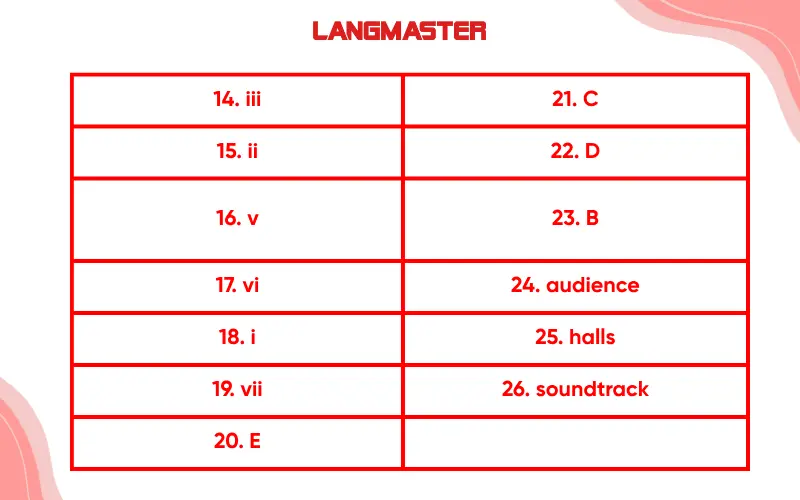
Dưới đây là bảng đáp án để đối chiếu:
|
14. iii |
21. C |
|
15. ii |
22. D |
|
16. v |
23. B |
|
17. vi |
24. audience |
|
18. i |
25. halls |
|
19. vii |
26. soundtrack |
|
20. E |
Đáp án chi tiết 14 – 19:
14. Paragraph A → iii. A focus on survival limits the practice of classical music
“Art and music have flourished in those periods... in which the luxury of free time and material wealth has allowed such a culture to take precedence over more material matters.”
→ Nghệ thuật và âm nhạc chỉ phát triển khi con người không còn bị chi phối bởi nhu cầu sinh tồn cơ bản như “food and shelter”.
Đáp án: iii. A focus on survival limits the practice of classical music
15. Paragraph B → ii. More people gain access to live music
“The rise of an economically independent middle class meant that concert-going became a public activity for anyone who cared to buy a ticket.”
→ Sự phát triển của tầng lớp trung lưu độc lập về tài chính khiến việc đi nghe hòa nhạc trở thành hoạt động công cộng, ai cũng có thể tham dự.
Đáp án: ii. More people gain access to live music
16. Paragraph C → v. A range of scientific advances brings music to a wider audience
“Nothing has changed music over the last century more radically than the invention and dissemination of recording technologies.”
→ Những tiến bộ công nghệ như máy ghi âm, CD, MP3 khiến âm nhạc được lan tỏa rộng rãi hơn bao giờ hết.
Đáp án: v. A range of scientific advances brings music to a wider audience
17. Paragraph D → vi. Listening to music being limited to live performances
“Before recording, music was a social event… people who wanted to listen to music went to a specific venue, at a specific time, to hear musicians create a one-off event.”
→ Trước khi có ghi âm, âm nhạc chỉ tồn tại trong các buổi biểu diễn trực tiếp, không thể nghe lại.
Đáp án: vi. Listening to music being limited to live performances
18. Paragraph E → i. Music comes to be enjoyed in a large variety of situations
“Technology makes almost all the world’s music instantly available… all music, classical music included, can be any person’s soundtrack for activities such as commuting, exercising, or working.”
→ Nhờ công nghệ, âm nhạc có thể được nghe ở mọi lúc, mọi nơi – khi đi làm, tập thể dục, làm việc…
Đáp án: i. Music comes to be enjoyed in a large variety of situations
19. Paragraph F → vii. How classical music has managed to survive for centuries
“At its heart is the idea of music that has remained viable over the years because it was written down in notation.”
→ Classical music tồn tại qua hàng thế kỷ vì được ghi chép bằng ký hiệu nhạc (notation), giúp bảo tồn và truyền lại.
Đáp án: vii. How classical music has managed to survive for centuries
Đáp án chi tiết 20 – 21:
20. E. The CD was popular for a relatively brief period.
“From the mid-1980s onwards… but just a decade later, the digital MP3 file was already displacing the CD.”
→ CD chỉ phổ biến trong thời gian ngắn (khoảng một thập kỷ) trước khi bị thay thế bởi MP3.
Đáp án: E
21. C. Electronic storage allows people to keep a vast amount of music.
“People have more music stored on their phones or computers… than all the metres of library shelves of a proud record collector.”
→ Công nghệ lưu trữ điện tử cho phép mỗi người sở hữu lượng nhạc khổng lồ mà trước đây không thể tưởng tượng được.
Đáp án: C
Đáp án chi tiết 22 – 23:
22. D. Classical music could not have survived without it.
“At its heart is the idea of music that has remained viable over the years because it was written down in notation.”
→ Nhờ có hệ thống ký âm mà classical music mới tồn tại và phát triển qua hàng thế kỷ.
Đáp án: D
23. B. It was originally designed as a memory aid.
“The first attempts to notate music were intended to help them remember these chants.”
→ Ban đầu, notation ra đời nhằm giúp các ca sĩ nhớ lời và giai điệu thánh ca.
Đáp án: B
Đáp án chi tiết 24 – 26:
24. audience
“It is no longer restricted to a particular audience or group of musicians.”
→ Âm nhạc không còn gắn với một nhóm khán giả cụ thể nào.
Đáp án: audience
25. halls
“One of its distinctive features—a performance defined by concert halls and opera houses—is dissolved by recording formats.”
→ Những địa điểm truyền thống như nhà hát opera hay concert halls không còn giữ vai trò trung tâm.
Đáp án: halls
26. soundtrack
“All music, classical music included, can be any person’s soundtrack for activities such as commuting, exercising, or working.”
→ Âm nhạc, kể cả classical, nay trở thành “soundtrack” cho mọi hoạt động hàng ngày của con người.
Đáp án: soundtrack
| Học mãi mà IELTS không lên band? Học thử IELTS miễn phí cùng giáo viên 7.5+, chấm chữa lỗi sai ngay lập tức. 👉 Đăng ký học thử miễn phí ngay |
>>> XEM THÊM:
Khi chuẩn bị cho kỳ thi IELTS Reading, việc phát triển vốn từ vựng theo kế hoạch học tập rõ ràng chính là chìa khóa để nâng cao band điểm. Một trong những cách hiệu quả nhất là giải đề IELTS Reading thường xuyên, kết hợp với luyện tập từ vựng trong các bài đọc học thuật. Dưới đây là tổng hợp từ vựng quan trong trong bài đọc “Classical music over the centuries” giúp bạn tăng tốc độ đọc hiểu, cải thiện kỹ năng phân tích và từng bước nâng cao kết quả khi làm bài thi thật.
|
Từ vựng / Cụm từ |
Nghĩa tiếng Việt |
Ví dụ trong bài |
|
flourish |
phát triển mạnh mẽ, hưng thịnh |
“Art and music have flourished in those periods of history…” |
|
luxury of free time |
sự xa xỉ của thời gian rảnh |
“…in which the luxury of free time and material wealth has allowed such a culture to take precedence…” |
|
take precedence over |
được ưu tiên hơn |
“…such a culture to take precedence over more material matters.” |
|
monastery |
tu viện |
“…in the closed communities of the church and monastery…” |
|
economically independent middle class |
tầng lớp trung lưu độc lập về kinh tế |
“…the rise of an economically independent middle class meant that concert-going became a public activity…” |
|
concert-going |
việc đi xem hòa nhạc |
“…concert-going became a public activity for anyone who cared to buy a ticket.” |
|
paying audience |
khán giả mua vé |
“…Performing music in concert halls to a paying audience was pretty much unheard of until the 18th century.” |
|
masterpieces |
kiệt tác |
“…the idea of masterpieces of classical music were all effectively invented during the course of the 18th century…” |
|
disseminate |
phổ biến, lan truyền |
“…nothing has changed music over the last century more radically than the invention and dissemination of recording technologies.” |
|
phonograph |
máy quay đĩa, máy hát cổ điển |
“…although Thomas Edison originally developed the phonograph in 1877…” |
|
wax cylinder |
trụ sáp (ghi âm thời xưa) |
“…and wax cylinders were used as early as the 1880s for recording music…” |
|
vinyl disc |
đĩa than |
“…the vinyl disc gradually gave way to the new technology of the CD…” |
|
MP3 file |
tệp nhạc kỹ thuật số MP3 |
“…the digital MP3 file was already displacing the CD as the favoured way to produce recorded music.” |
|
record collector |
người sưu tầm đĩa nhạc |
“…than would have been contained on all the metres of library shelves of a proud ‘record collector’ of the 20th century.” |
|
one-off event |
sự kiện diễn ra một lần |
“…to hear musicians create a one-off event.” |
|
venue |
địa điểm tổ chức |
“…people who wanted to listen to music went to a specific venue, at a specific time…” |
|
instantly available |
có sẵn ngay lập tức |
“…technology makes almost all the world’s music instantly available to anyone with access to simple and cheap gadgets…” |
|
dissolve |
tan biến, biến mất |
“…a performance defined by concert halls and opera houses is dissolved by recording formats.” |
|
notation |
ký hiệu âm nhạc, bản nhạc chép tay |
“…the idea of music that has remained viable over the years because it was written down in notation.” |
|
chant |
thánh ca |
“…singers in religious services… had to learn by heart a huge repertory of chants.” |
|
repertory |
kho bài hát, tiết mục |
“…had to learn by heart a huge repertory of chants.” |
|
refine |
trau chuốt, tinh chỉnh |
“…allowing composers to rework and refine their musical ideas.” |
|
viable |
có thể tồn tại, bền vững |
“…music that has remained viable over the years because it was written down in notation.” |
|
ubiquity |
sự phổ biến khắp nơi |
“The ubiquity of music as recorded sound means that it's very easy to overlook…” |
|
commute |
đi làm hằng ngày |
“…can be any person’s soundtrack for activities such as commuting, exercising, or working.” |
>>> XEM THÊM:
Khi thực hành với đề IELTS Reading “Classical music over the centuries”, học viên thường gặp thách thức trong việc phân tích dạng bài và vận dụng từ vựng học thuật một cách hiệu quả. Để tối ưu kết quả, việc xây dựng lộ trình ôn tập khoa học kết hợp cùng sự hướng dẫn từ giáo viên giàu kinh nghiệm sẽ mang lại lợi ích rõ rệt.
Để đáp ứng nhu cầu, Langmaster xây dựng các khóa học IELTS online với lộ trình cá nhân hóa. Học viên sẽ được giảng viên theo sát, chỉ ra lỗi sai ngay lập tức trong vòng 24 giờ và hướng dẫn phương pháp học tập tối ưu để tiến bộ nhanh chóng hơn.

Tại Langmaster học viên được:
Đăng ký học thử IELTS Online miễn phí ngay hôm nay để trải nghiệm lớp học thực tế, kiểm tra trình độ và nhận lộ trình học tập hiệu quả, giúp bạn thành thạo kỹ năng IELTS Writing và chinh phục mục tiêu IELTS!
Việc ôn luyện với đề IELTS Reading “Classical Music over the Centuries” không chỉ giúp bạn củng cố kiến thức mà còn rèn luyện khả năng phân tích và tư duy logic trong từng dạng câu hỏi. Hãy duy trì luyện tập đều đặn mỗi ngày để đạt kết quả tốt nhất, chúc bạn học tập hiệu quả và chinh phục mục tiêu IELTS như mong muốn!




Các dạng bài phổ biến và tiêu chí chấm điểm IELTS Reading chi tiết nhất: Multiple Choice, Matching Information, Matching Headings,... và hướng dẫn chiến lược làm bài hiệu quả
Những sai lầm khi luyện IELTS Reading bao gồm: dịch từng từ, đọc hết cả bài, không đọc câu hỏi trước, không quản lý thời gian, không nắm vững kỹ năng paraphrase, viết sai chính tả
![Giải đề IELTS Reading: A brief history of humans and food [full answers]](https://langmaster.edu.vn/storage/images/2025/09/20/a-brief-history-of-humans-and-food-ielts-reading-answers.webp)
Giải đề thi IELTS Reading “A brief history of humans and food” kèm full đề thi thật, câu hỏi, đáp án, giải thích chi tiết, và từ vựng cần lưu ý khi làm bài.

Tổng hợp IELTS Reading tips hay nhất giúp bạn đọc nhanh, nắm ý chính và xử lý thông tin chính xác, tự tin đạt điểm cao trong kỳ thi IELTS.
![Giải đề IELTS Reading: The importance of law [Full answers]](https://langmaster.edu.vn/storage/images/2025/09/22/55.webp)
Giải đề IELTS Reading “The importance of law” kèm đáp án chi tiết, từ vựng quan trọng và bí quyết luyện thi hiệu quả để nâng cao band điểm.





Hơn 16 năm kinh nghiệm, đào tạo thành công 800.000+ học viên
Phương pháp giảng dạy hiện đại, học viên tiến bộ rõ rệt
Lộ trình học chuẩn quốc tế, phù hợp với nhu cầu thực tiễn
Giáo viên đạt chuẩn Quốc tế với chất lượng top đầu thị trường, giàu kinh nghiệm
Học online linh hoạt, cam kết đầu ra bằng văn bản

![Giải đề Stonehenge [IELTS Reading Cambridge 18, Test 2, Reading Passage 1]](https://langmaster.edu.vn/storage/uploads/original/2025/10/10/stonehenge-ielts-reading.png)

![Giải đề IELTS Reading: Neuroaesthetics [Full answers]](https://langmaster.edu.vn/storage/uploads/original/2025/10/11/giai-de-ielts-reading-neuroaesthetics.png)